
Internal Linking Strategy for Better SEO Rankings: The Complete Guide
Table of Contents
What Is an Internal Linking Strategy for Better SEO Rankings?
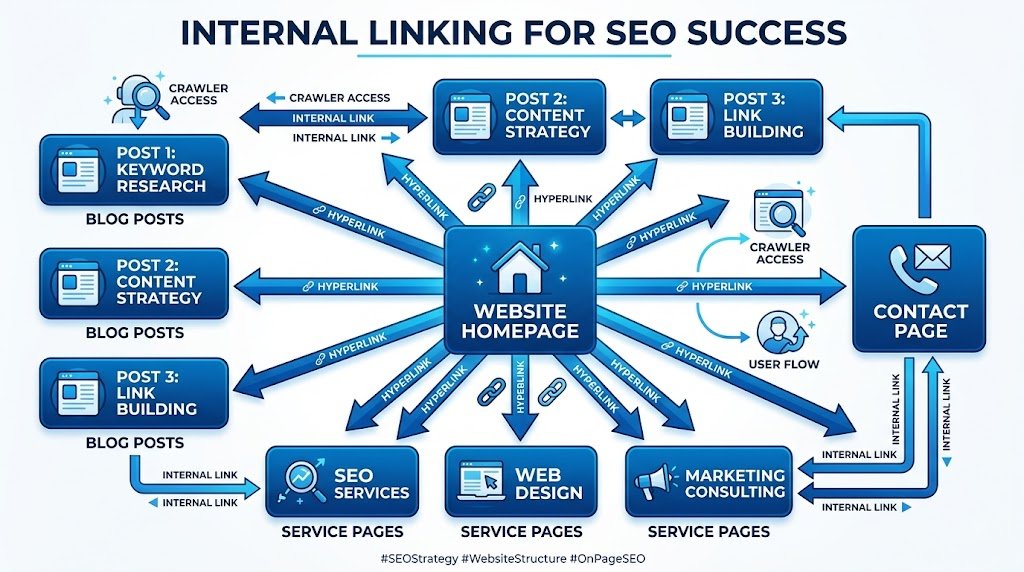
An Internal Linking Strategy for Better SEO Rankings is the process of connecting pages within the same website through hyperlinks. These links help users navigate your website and help search engines understand the relationship between different pages.
Internal links play a crucial role in SEO because they distribute link authority, improve website structure, and enhance user experience. Therefore, every website should implement a strong internal linking strategy to achieve better search engine rankings.
When search engine bots crawl a website, they follow internal links to discover new pages. As a result, properly linked pages are more likely to be indexed and ranked by search engines.
In addition, internal linking helps visitors find relevant content. Consequently, users spend more time on your website, which can positively impact SEO performance.
Why an Internal Linking Strategy for Better SEO Rankings Is Important
Many website owners focus heavily on backlinks. However, they often ignore internal linking.
A strong internal linking strategy provides several SEO benefits.
Improves Website Crawling
Search engines use links to discover pages.
When pages are linked properly, search engine crawlers can access and index content more efficiently.
Distributes Link Authority
Some pages naturally receive more backlinks than others.
Internal links help distribute authority from strong pages to other important pages.
Enhances User Experience
Visitors can easily find related content through internal links.
Therefore, they spend more time exploring your website.
Reduces Bounce Rate
Users are more likely to visit additional pages when relevant links are available.
As a result, bounce rates may decrease.
Supports Higher Rankings
Search engines better understand your website structure when internal linking is implemented correctly.
Consequently, rankings often improve.
How Internal Links Work in SEO
Internal links connect one page of a website to another page on the same domain.
For example:
- Homepage → Services Page
- Services Page → SEO Service Page
- Blog Post → Related Blog Post
- About Page → Contact Page
These connections create a clear website structure.
Search engines use these links to determine:
- Page importance
- Content relevance
- Website hierarchy
- User navigation paths
Therefore, every important page should receive internal links from relevant pages.
Types of Internal Links
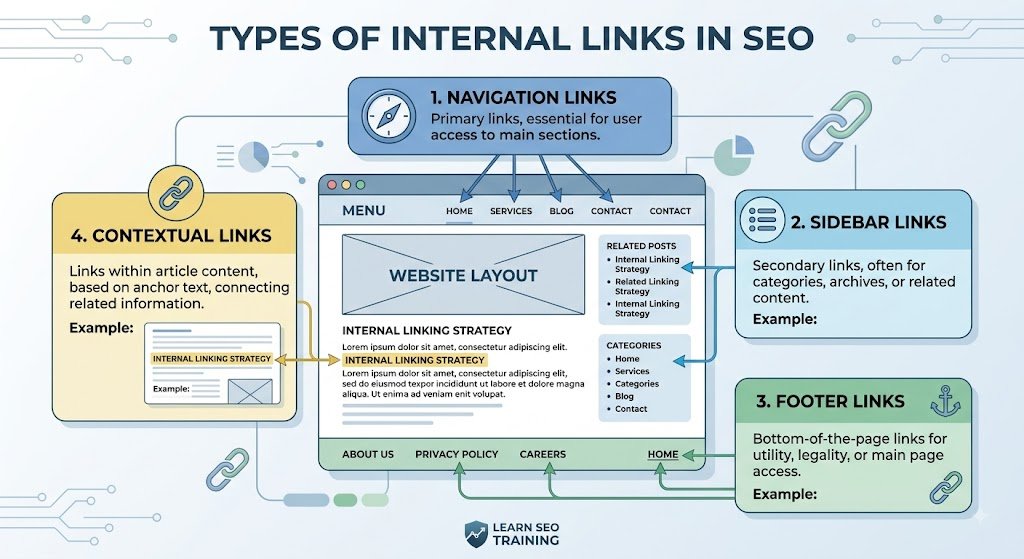
Understanding different types of internal links helps create a more effective strategy.
Navigational Links
These links appear in:
- Main menus
- Header navigation
- Footer navigation
They help users move between important sections of a website.
Contextual Links
Contextual links are placed within content.
For example:
If you are writing about keyword research, you can link to another article about SEO tools.
These links are highly valuable because they provide context to search engines.
Footer Links
Footer links appear at the bottom of web pages.
They often connect users to:
- Contact pages
- Privacy policy
- Important services
Sidebar Links
Sidebar links help users discover related content.
They are commonly used on blogs and news websites.
Benefits of an Internal Linking Strategy for Better SEO Rankings
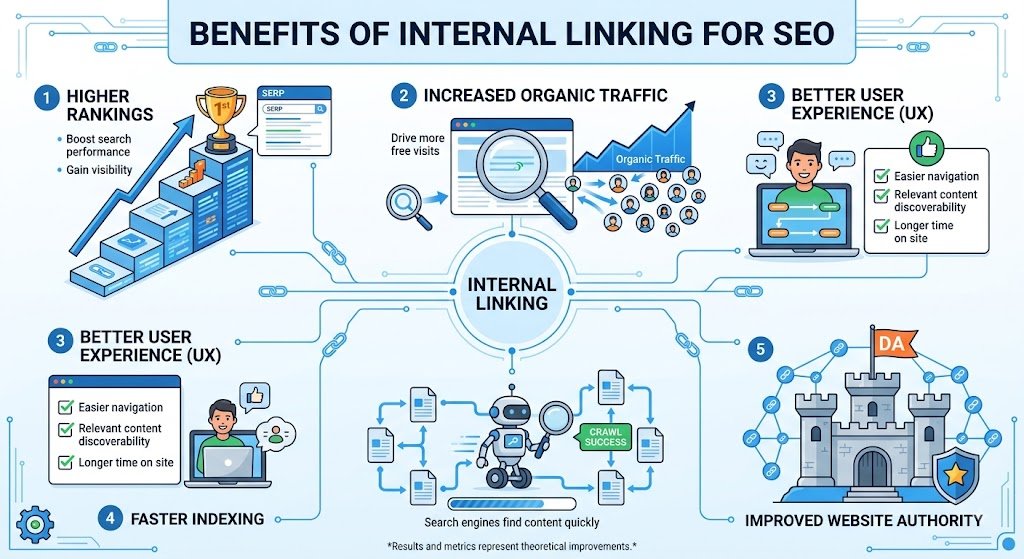
Better Page Authority Distribution
Every website contains pages with different levels of authority.
Internal links help transfer authority from stronger pages to weaker pages.
As a result, multiple pages can perform better in search results.
Improved Content Discoverability
Search engines discover content through links.
Without internal links, some pages may become orphan pages.
Orphan pages are pages that have no links pointing to them.
Therefore, search engines may struggle to find and index them.
Increased Page Views
Internal links encourage users to continue browsing.
Consequently, website page views often increase.
Stronger Topical Relevance
When related pages link to each other, search engines better understand the topic.
As a result, the website gains topical authority.
Faster Indexing
New pages receive attention faster when linked from existing pages.
Therefore, indexing speed improves significantly.
According to Ahrefs, internal links help search engines discover pages, understand content relationships, and distribute authority across a website. Learn more in the Ahrefs Internal Links Guide.
Creating an Effective Internal Linking Strategy for Better SEO Rankings
Step 1: Identify Important Pages
Begin by identifying your most important pages.
Examples include:
- Service pages
- Product pages
- Landing pages
- Cornerstone content
These pages should receive the highest number of internal links.
Step 2: Create Topic Clusters
Topic clusters help organize content.
For example:
Main Topic:
- SEO
Supporting Topics:
- Keyword Research
- Technical SEO
- On-Page SEO
- Off-Page SEO
- Link Building
All supporting articles should link back to the main topic page.
Similarly, the main page should link to supporting content.
Step 3: Use Relevant Anchor Text
Anchor text is the clickable text of a link.
Good example:
“Learn more about technical SEO best practices.”
Poor example:
“Click here.”
Descriptive anchor text helps search engines understand linked content.
Step 4: Link Related Content Naturally
Internal links should appear naturally within content.
Avoid forcing links where they do not make sense.
Instead, focus on relevance.
Step 5: Update Old Content
Older blog posts often have authority.
Therefore, update old articles with links to newer content.
This helps distribute authority throughout the website.
Best Practices for Internal Linking Strategy for Better SEO Rankings
Use Descriptive Anchor Text
Anchor text should describe the destination page.
For example:
Good:
- SEO audit checklist
- On-page SEO guide
Bad:
- Read more
- Click here
Link to Important Pages More Often
Pages that generate leads or revenue should receive additional internal links.
Maintain a Logical Structure
Website structure should be simple and organized.
Example:
Homepage
→ Services
→ SEO Services
→ Technical SEO Services
This hierarchy helps both users and search engines.
Avoid Overloading Pages
Too many internal links can confuse users.
Therefore, include only relevant links.
Check Broken Links Regularly
Broken internal links create poor user experiences.
Therefore, perform regular website audits.
Advanced Internal Linking Techniques for Better SEO Rankings
Once you understand the basics of internal linking, the next step is implementing advanced strategies that can further improve your website’s SEO performance. These techniques help search engines understand content relationships while also improving user engagement.
Use Hub and Spoke Content Structure
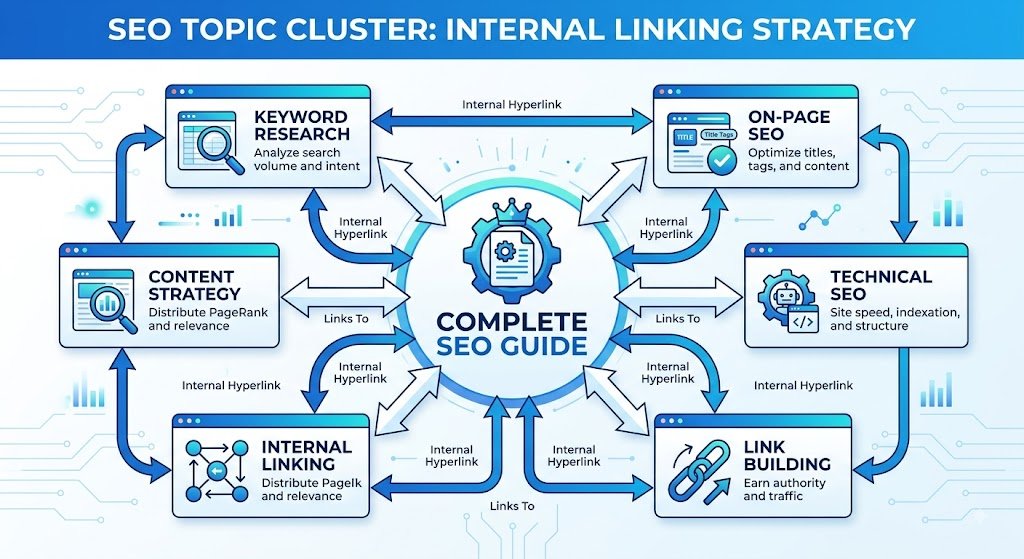
A hub and spoke structure is one of the most effective internal linking methods.
In this model, a central page covers a broad topic while several supporting pages discuss related subtopics.
For example:
Hub Page
- Complete SEO Guide
Spoke Pages
- Keyword Research Guide
- On-Page SEO Guide
- Technical SEO Guide
- Link Building Guide
- Internal Linking Guide
Each spoke page should link back to the hub page. Likewise, the hub page should link to every supporting article.
As a result, search engines can easily identify the main topic and supporting content.
Prioritize High-Value Pages
Not all pages have equal importance.
Some pages generate leads, sales, or conversions. Therefore, these pages should receive more internal links than less important pages.
Examples include:
- Service Pages
- Product Pages
- Contact Pages
- Landing Pages
By directing more internal links to these pages, you increase their authority and visibility.
Link from High-Traffic Pages
Certain pages already receive significant traffic from search engines.
These pages are excellent locations for adding internal links.
When visitors land on these pages, they can easily discover related content through internal links.
Consequently, page views and user engagement often increase.
Create Content Silos
Content silos help organize website content into specific categories.
For example:
SEO Category
- Keyword Research
- Technical SEO
- On-Page SEO
- Internal Linking
Digital Marketing Category
- Google Ads
- Social Media Marketing
- Email Marketing
Pages within the same category should frequently link to each other.
This creates stronger topical relevance and improves search engine understanding.
Use Breadcrumb Navigation
Breadcrumbs help users understand their current location on a website.
Example:
Home → SEO → On-Page SEO → Internal Linking
Breadcrumb links provide additional internal links and improve navigation.
As a result, users can easily move between related sections.
Optimize Internal Links for User Intent
Every internal link should serve a purpose.
Before adding a link, ask:
- Is this useful for the reader?
- Does it provide additional information?
- Is it relevant to the topic?
If the answer is yes, the link is likely beneficial.
Relevant internal links improve user satisfaction and website engagement.
Improve Deep Page Visibility
Many websites have valuable pages hidden several clicks away from the homepage.
These pages often receive less traffic.
Therefore, adding internal links from popular pages can improve their visibility.
This strategy helps search engines discover and index deeper content more effectively.
Update Internal Links Regularly
Internal linking is not a one-time task.
As your website grows, new content is published regularly.
Therefore, older articles should be updated with links to newer content.
For example:
If you publish a new article about Technical SEO, update older SEO-related articles with links to the new page.
This practice strengthens your website structure and improves content discoverability.
Monitor User Navigation Patterns
Understanding how visitors move through your website can reveal new internal linking opportunities.
Monitor metrics such as:
- Pages per session
- Time on site
- User flow reports
- Exit pages
If users frequently leave a page without exploring additional content, consider adding more relevant internal links.
Balance Internal Links Across the Website
A common mistake is linking heavily to only a few pages.
Instead, distribute links strategically across important content.
A balanced linking structure ensures that authority flows throughout the website.
Consequently, multiple pages can benefit from improved rankings rather than a small group of pages.
Internal Linking and Long-Term SEO Success
Internal linking remains one of the most controllable SEO factors.
Unlike backlinks, which depend on external websites, internal links are completely under your control.
Therefore, every website owner should invest time in creating a strong internal linking strategy.
When implemented consistently, internal linking improves crawling, indexing, user experience, page authority distribution, and search engine rankings.
Over time, these improvements contribute to sustainable organic growth and long-term SEO success.
Common Internal Linking Mistakes
Using Generic Anchor Text
Generic phrases provide little SEO value.
Instead, use keyword-rich anchor text naturally.
Linking Irrelevant Pages
Links should always be relevant to the topic.
Irrelevant links reduce user experience.
Creating Orphan Pages
Every important page should receive at least one internal link.
Ignoring Deep Pages
Deep pages often receive fewer links.
Therefore, include links to these pages whenever possible.
Excessive Internal Linking
Adding too many links may dilute their value.
Balance is important.
Internal Linking and Topic Clusters
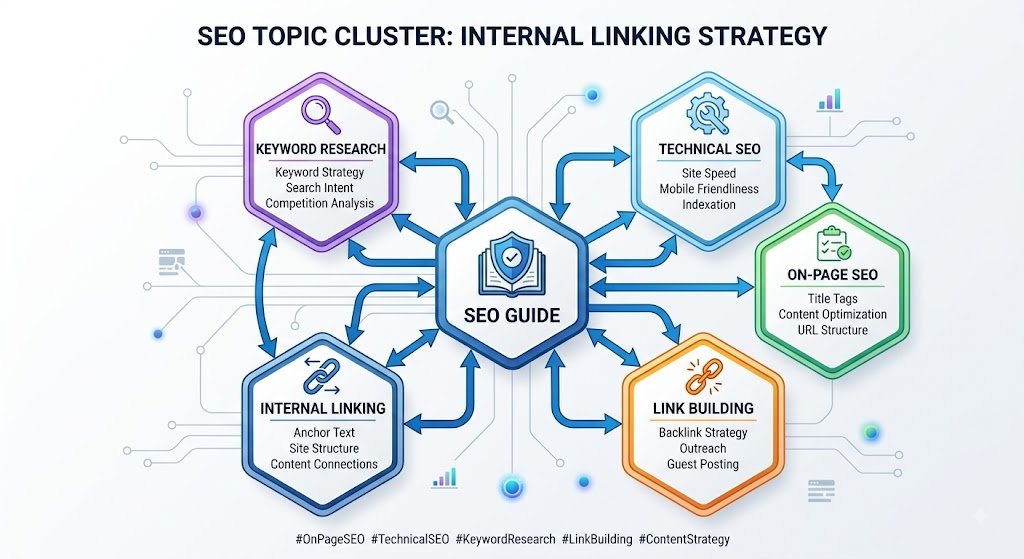
Topic clusters are becoming increasingly important in SEO.
A topic cluster consists of:
Pillar Page
A comprehensive page covering a broad topic.
Example:
- Complete SEO Guide
Cluster Content
Supporting articles that cover subtopics.
Examples:
- Keyword Research Guide
- Technical SEO Guide
- Link Building Strategies
- Internal Linking Strategy Guide
All cluster articles should link to the pillar page.
Similarly, the pillar page should link to all cluster articles.
This structure strengthens topical authority.
Internal Linking Tools for SEO
Several tools can help manage internal links.
Google Search Console
Helps identify top-linked pages.
Ahrefs
Provides internal link opportunities.
SEMrush
Offers site audit reports and internal linking suggestions.
Rank Math
Suggests internal links while creating content.
Screaming Frog
Identifies broken links and orphan pages.
These tools simplify internal linking optimization.
Measuring the Success of Your Internal Linking Strategy
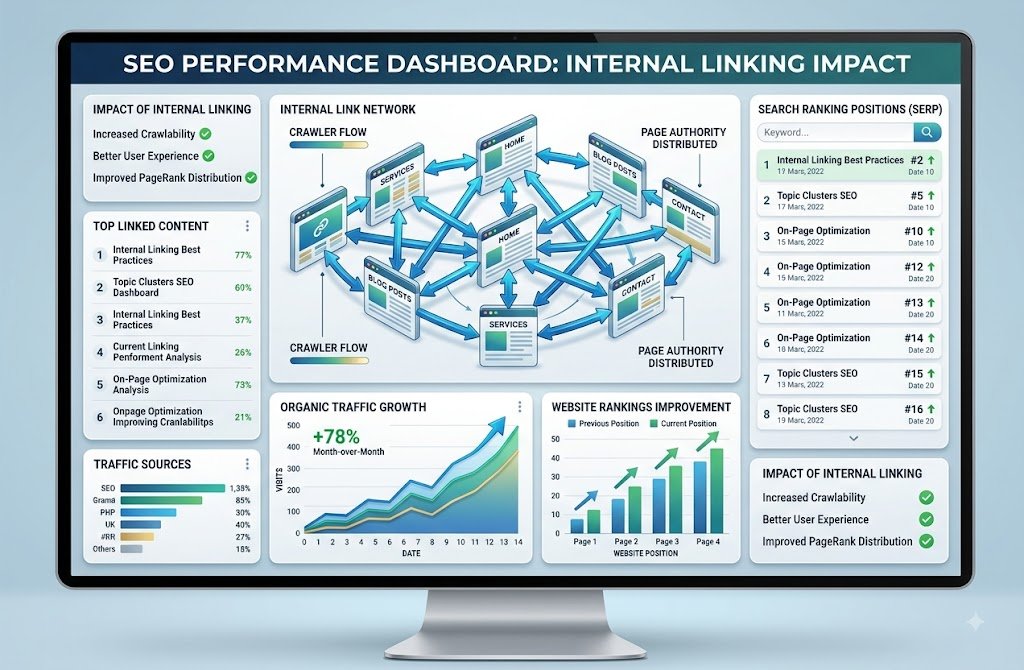
After implementing an internal linking strategy, monitor performance.
Key metrics include:
Organic Traffic
Check whether traffic increases over time.
Page Views
Monitor pages visited per session.
Average Session Duration
Longer sessions often indicate better navigation.
Indexing Status
Ensure important pages are indexed.
Keyword Rankings
Track rankings for targeted keywords.
Regular monitoring helps identify areas for improvement.
Future of Internal Linking in SEO
Search engines continue evolving.
However, internal linking remains a fundamental ranking factor.
Future trends include:
AI-Powered Content Relationships
Search engines are becoming better at understanding content connections.
Topic Authority
Websites with strong topic clusters will likely perform better.
User Experience Signals
Internal linking improves navigation and engagement.
Therefore, its importance will continue growing.
Semantic SEO
Search engines increasingly focus on content relationships.
Internal links help establish those relationships.
Conclusion
An effective Internal Linking Strategy for Better SEO Rankings is essential for improving website visibility, user experience, and search engine performance.
Internal links help search engines discover pages, distribute authority, and understand content relationships. Furthermore, they encourage visitors to explore more content and spend additional time on your website.
By using descriptive anchor text, creating topic clusters, linking relevant pages, and maintaining a logical site structure, you can build a powerful internal linking strategy that supports long-term SEO success.
If implemented correctly, internal linking can significantly improve rankings, increase organic traffic, and strengthen your website’s overall authority.